Call (615) 936 7846 to schedule a consultation.

Nicholas Strasser MD
  • Home
  • Rehab Protocols | Therapy
    • Total ankle Arthroplasty
    • Haglunds Rehab Protocol
    • Achilles Tendon Tear
    • Brostrom Protocol
    • Fifth metatarsal (jones)
    • Anterior Tibial Tendon
    • Lisfranc Rehab
    • Osteochondral Repair
  • FAQ
  • Surgery Preparation
    • Preparing for Surgery
    • Postop Rehab
    • Swelling After Surgery
    • Foot and Ankle Procedures
  • Orthopedic Indications
  • Blog
    • Choosing an Ankle Brace

Osteochondral Debridement/Repair Protocol

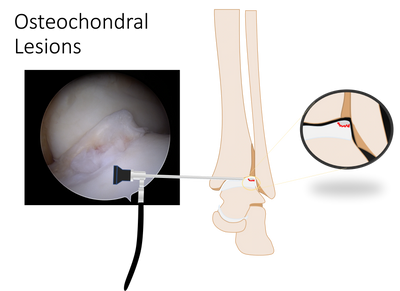
Ankle Arthroscopy with Osteochondral Lesion Debridement and Particulate Articular Allograft

Primary Goals:

  • Protect the cartilage repair from shear stress during early healing
  • Restore ankle range of motion without axial or torsional loading 
  • Gradually reintroduce loading and impact in a controlled fashion

Key Restrictions:

  • Avoid shear stress across the ankle for the first 6 weeks
  • Avoid impact activities for 4–6 months postoperatively 


Phase 1: Weeks 0–2

Weight Bearing:

  • Non-weight bearing or touch-down weight bearing in a splint or boot (per surgeon preference)
     

Immobilization:

  • Splint or CAM boot at all times except for hygiene and prescribed exercises
     

Range of Motion:

  • Begin ankle range of motion out of the boot
     
  • Active and active-assisted dorsiflexion and plantarflexion only
     
  • Range of motion exercises must be performed non-weight-bearing
     

Restrictions:

  • No inversion or eversion
  • No loaded dorsiflexion
  • No squatting, lunges, or step-downs
  • No pivoting or torsional movements

Other:

  • Edema control, elevation, cryotherapy as needed
     

Phase 2: Weeks 2–6

Weight Bearing:

  • Progress to partial weight bearing, advancing to weight bearing as tolerated in boot only
     

Range of Motion:

  • Continue non-weight-bearing dorsiflexion and plantarflexion 
  • Gentle inversion and eversion may begin at surgeon discretion, performed non-weight-bearing only
     

Strengthening:

  • Isometric exercises in neutral position only
  • No resisted ankle strengthening
     

Restrictions:

  • No shear-loading activities
  • No closed-chain dorsiflexion
  • No strengthening in weight-bearing
  • No pivoting, twisting, or uneven surfaces
     

Phase 3: Weeks 6–10

Weight Bearing:

  • Transition out of boot into supportive shoe or brace as tolerated
     

Range of Motion:

  • Full ankle range of motion in all planes
     

Strengthening:

  • Begin closed-chain strengthening
  • Progressive loading into dorsiflexion
  • Proprioceptive and balance training

Restrictions:

  • No running, jumping, or impact activities
     

Phase 4: Weeks 10–16

Strengthening:

  • Advance lower extremity strengthening 
  • Progress proprioception and neuromuscular control

Conditioning:

  • Low-impact cardiovascular conditioning (cycling, elliptical, swimming)

Restrictions:

  • No impact loading
  • No cutting or pivoting activities

Phase 5: Months 4–6

Impact Progression:

  • Gradual return to impact activities as tolerated and cleared by surgeon
  • Begin straight-line jogging, progressing to sport-specific drills 

Goals:

  • Restore strength, endurance, and neuromuscular control 
  • Prepare for return to full athletic participation
     

Return to Sport

  • Low-impact activities: after 6–8 weeks 
  • Running and impact activities: no earlier than 4 months postoperatively
  • Full return to sport: typically 4–6 months postoperatively, depending on lesion size, location, and clinical progress

Copyright © 2024 Sports Foot and Ankle Specialist - All Rights Reserved.

Powered by

  • Orthopedic Indications

This website uses cookies.

We use cookies to analyze website traffic and optimize your website experience. By accepting our use of cookies, your data will be aggregated with all other user data.

Accept